
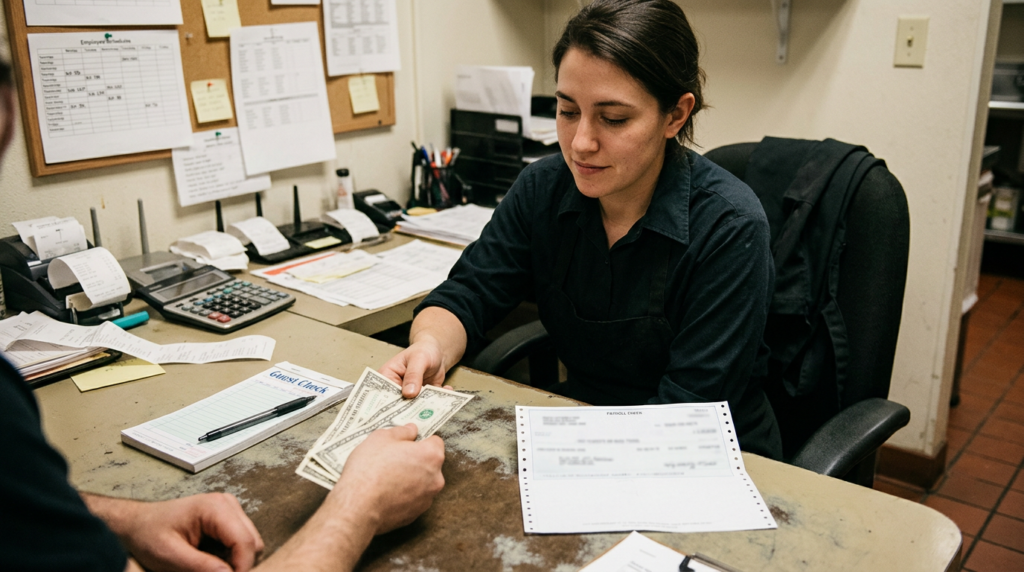
If you run a restaurant, salon, retail shop or any business with hourly staff, your January W-2s will look different this year. Starting with the 2026 tax year, employers must report qualified overtime and qualified tips as separate amounts on Form W-2. Employees will rely on those numbers to claim the new federal deductions for tips and overtime, so if the numbers are wrong, your phone will ring in February.
The good news: there is still time to get payroll set up correctly before December 31. Here is what changed and what to do now.
What changed
The 2025 federal tax law created two temporary deductions for workers, available for tax years 2025 through 2028:
- No tax on tips: up to $25,000 of qualified tips per return.
- No tax on overtime: up to $12,500 of qualified overtime pay ($25,000 for married couples filing jointly).
Both deductions start to phase out once a worker’s modified adjusted gross income passes $150,000 ($300,000 for joint filers).
For 2025, the IRS gave employers penalty relief and let them report these amounts any reasonable way, such as a note in Box 14 or a separate statement. That relief is over. On the 2026 Form W-2, due to employees by February 1, 2027 (January 31 falls on a Sunday), the amounts go in Box 12:
- Code TT for qualified overtime compensation
- Code TP for qualified tips
What counts as “qualified” (and what does not)
Overtime: only the premium portion required by the federal Fair Labor Standards Act counts, meaning the extra “half” in time-and-a-half. If an employee earns $20 an hour and is paid $30 for an overtime hour, only $10 of that hour is qualified overtime. Overtime you pay because of a state or local rule, a union contract or your own policy, beyond what federal law requires, does not count.
Tips: tips must be voluntary, set by the customer, and paid in cash or by card, to a worker in an occupation the IRS lists as customarily tipped. Mandatory service charges and automatic gratuities do not qualify. If you add an 18% service charge for large parties, that money is wages, not qualified tips.
A Maryland catch your employees should know about
These are federal deductions only. The Maryland Comptroller has confirmed that because they are taken after federal adjusted gross income, they do not reduce Maryland income tax. Your Maryland withholding does not change, and your employees should not expect a smaller state or county tax bill. A one-line note in your next payroll communication can head off a lot of confused questions.
Your year-end checklist
- Split overtime in payroll. Make sure your payroll system tracks the FLSA overtime premium separately from regular pay and from any extra overtime you pay voluntarily or under state rules.
- Map tipped positions. Match each tipped role (servers, bartenders, stylists, delivery drivers and so on) to the IRS list of tipped occupations.
- Separate tips from service charges. Check that card tips, tip pools and tip-sharing flow into payroll correctly, and that mandatory service charges are coded as wages.
- Ask your payroll provider about Box 12. Confirm in writing that your 2026 W-2s will populate codes TT and TP, and when you will see a preview.
- Look back at January through now. If your setup was wrong earlier in the year, fix the year-to-date totals before the last payroll of December, not after the W-2s go out.
- Keep normal withholding. Nothing changes for withholding, Social Security or Medicare. Tips and overtime are still fully taxable wages for payroll purposes.
Why it is worth getting right now
Correcting W-2s after they are filed means filing Forms W-2c, answering employee questions and, if the errors are widespread, risking information-return penalties. A short review in November is far cheaper than a cleanup in March.
HAMTOCK Consulting helps Silver Spring and Montgomery County employers set up payroll and review year-end reporting. If you would like a second look at how your payroll handles tips and overtime before W-2 season, call us at 240-432-2749 or email contact@hamtock.com.
This article is general information, not tax advice for your specific situation. Rules are current as of October 2026; check the final 2026 Form W-2 instructions or talk with us before acting.