
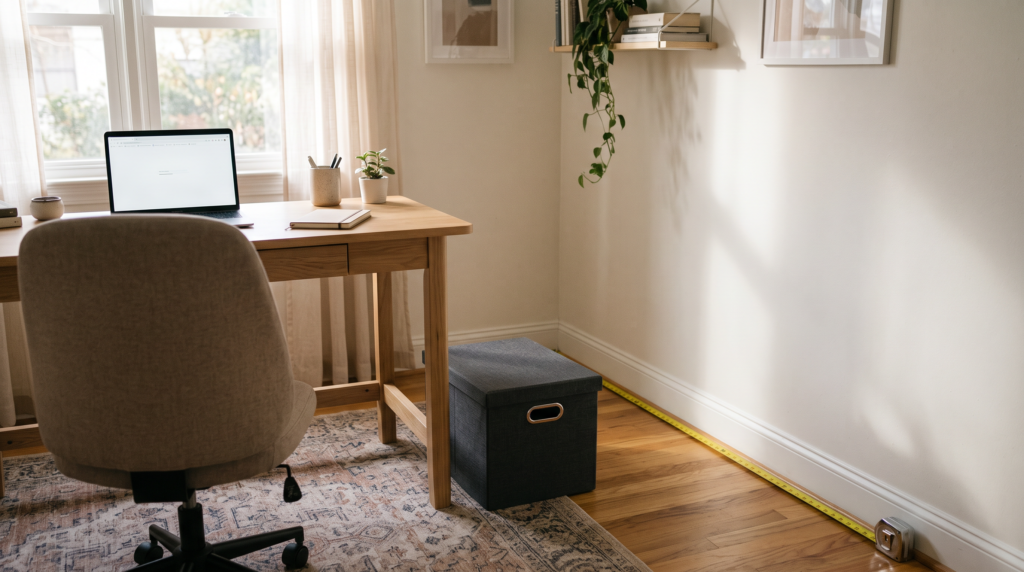
Many of our clients run their business from a spare room, a basement office or a corner of the dining room. If that describes you, part of what you spend on your home may be deductible on your 2026 return. The rules are strict about who qualifies, and the IRS offers two ways to calculate the deduction. Choosing the right one is worth a few minutes before the year ends.
Who qualifies
The deduction is for people who are self-employed: sole proprietors, single-member LLC owners and independent contractors who file Schedule C. Under IRS Publication 587, the space must meet two tests:
- Regular and exclusive use. A specific area is used only for the business, on a regular basis. A desk in the guest room that guests also use does not count; a room or clearly defined area used for nothing else does.
- Principal place of business. It is where you do most of your work, or where you handle the administration (billing, bookkeeping, scheduling) and you have no other fixed location for it. A space where you regularly meet clients, or a separate structure such as a detached studio, can also qualify.
Two uses are exempt from the exclusive-use test: a licensed daycare run from the home, and storage of inventory or product samples when the home is your only fixed business location.
W-2 employees who work from home cannot claim the deduction, even if the employer requires remote work. That rule was temporary from 2018 and has now been made permanent. S corporation owners are employees of their own company, so the usual route is for the corporation to reimburse home office costs under a written accountable plan instead.
The simplified method
The simplified option is $5 per square foot of office space, up to 300 square feet, for a maximum of $1,500 a year. There is no depreciation to track and nothing to recapture when you sell the home. Homeowners still claim their full mortgage interest and property taxes as itemized deductions, subject to the usual limits. The trade-off: if your business income is too low to absorb the deduction, the unused amount is lost; it does not carry forward.
The regular method
The regular method uses Form 8829. You work out the business-use percentage (office square footage divided by the home’s total) and apply it to actual costs: rent or mortgage interest, property taxes, insurance, utilities, repairs and, for owners, depreciation on the home. Costs that apply only to the office, such as painting that room, are deducted in full.
It usually produces a larger deduction, and any amount your business income cannot absorb carries forward to next year. The cost is more record keeping, and for homeowners, the depreciation claimed is taxed when the home is sold.
A quick comparison
Here is an illustrative example, not a client’s figures. A consultant rents a 2,000-square-foot apartment and uses a 200-square-foot room only as an office, so the business-use percentage is 10%.
- Simplified: 200 square feet x $5 = $1,000.
- Regular: rent of $24,000 plus utilities and renter’s insurance of $3,600 is $27,600; 10% of that is $2,760.
For renters the regular method often wins, with no depreciation issue on a later sale. For homeowners with a small mortgage, the two can come out close, and the simplified method may be worth the peace of mind. You can choose a different method each year.
Two related benefits
If your home office is your principal place of business, trips from home to clients or suppliers count as business transportation rather than commuting, according to IRS Publication 463, so those miles are deductible. And because Maryland’s income tax starts from your federal adjusted gross income, the deduction flows through to your Maryland return automatically.
What to do before December 31
- Measure the office and the whole home, and take a dated photo of the space.
- Keep 2026 rent or mortgage statements, utility bills and insurance renewals in one folder. Our year-end bookkeeping checklist shows how to organize the rest.
- Make sure the space is used only for the business through the end of the year.
- If you are also weighing a retirement contribution, see our comparison of the Solo 401(k) and SEP IRA; the home office deduction lowers the net self-employment earnings your contribution limit is figured from.
Key takeaways
- Only the self-employed can claim the home office deduction; W-2 employees cannot.
- The space must be used regularly and only for the business.
- Simplified: up to $1,500, no depreciation, no carryover. Regular: often larger, more records, carries forward.
- Measure the space and gather the bills now.
This article is general information, not tax advice for your specific situation. The rules are current as of November 2026. If you would like us to compare both methods with your actual numbers, our tax planning service will run the calculation and tell you which one to use.